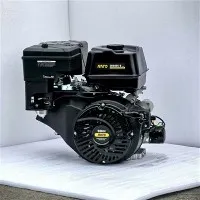
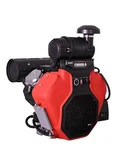
The engine is a machine that converts chemical energy into mechanical energy. Its conversion process is actually the process of working cycle. In simple terms, it burns the fuel in the cylinder to generate kinetic energy to drive the reciprocating movement of the piston in the engine cylinder. The connecting rod connected to the piston and the crank connected to the connecting rod make a reciprocating circular motion around the center of the crankshaft to output power.
The working process of a four-stroke gasoline engine is a complex process, which consists of four strokes (strokes): intake, compression, combustion expansion, and exhaust.
Intake stroke
At this time, the piston is driven by the crankshaft to move from top dead center to bottom top dead center. At the same time, the intake valve opens and the exhaust valve closes. When the piston moves from the top dead center to the bottom dead center, the volume above the piston increases, the gas pressure in the cylinder decreases, and a certain degree of vacuum is formed. As the intake valve opens, the cylinder communicates with the intake pipe, and the mixture is sucked into the cylinder. When the piston moves to the bottom dead center, the cylinder is filled with fresh mixed gas and exhaust gas that was not discharged in the previous working cycle.
Compression stroke
The piston moves from bottom dead center to top dead center, and the intake and exhaust valves are closed. The crankshaft is driven to rotate under the action of inertial force such as the flywheel, and the piston is pushed upward through the connecting rod. The gas volume in the cylinder gradually decreases, the gas is compressed, and the pressure and temperature of the mixed gas in the cylinder increase.
Work stroke
At this time, the intake and exhaust valves are closed at the same time, the spark plug is ignited, and the mixed gas is violently burned. The temperature and pressure in the cylinder rise sharply. The high temperature and high pressure gas pushes the piston down and drives the crankshaft to rotate through the connecting rod. In the four strokes of the engine's work, only this stroke can realize the conversion of heat energy into mechanical energy, so this stroke is also called the work stroke.
Exhaust stroke
At this time, the exhaust valve opens, the piston moves from bottom dead center to top dead center, and exhaust gas is discharged from the cylinder as the piston moves upward. Because the exhaust system has resistance and the combustion chamber also occupies a certain volume, it is impossible to exhaust the exhaust gas at the end of the exhaust gas. This part of the remaining exhaust gas is called the residual exhaust gas. The residual exhaust gas not only affects the charging, but also has an adverse effect on the combustion.
At the end of the exhaust stroke, the piston returns to the top dead center. This completes a work cycle. Subsequently, the crankshaft continues to rotate depending on the inertia of the flywheel, and the next cycle begins. After repeating this cycle, the engine keeps running.